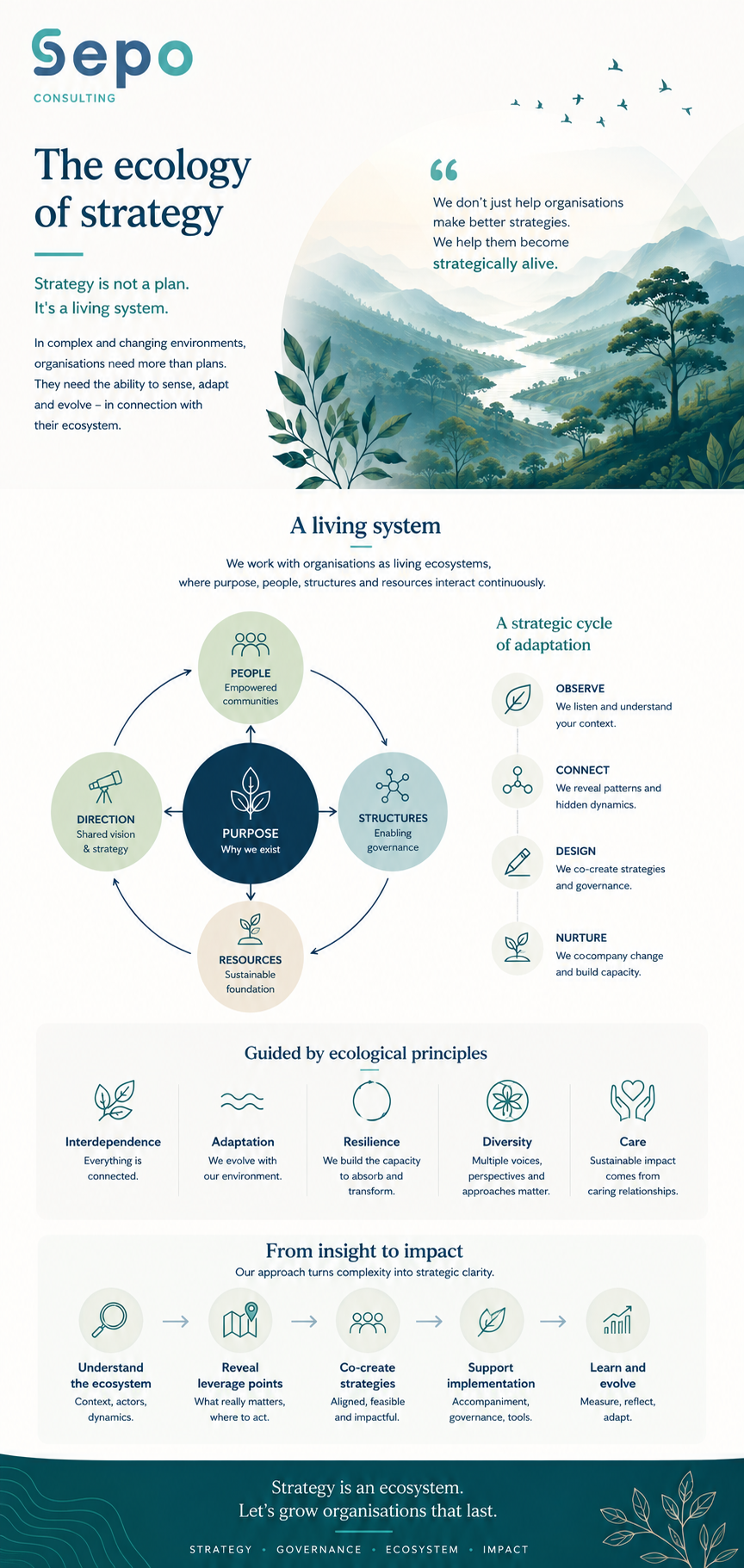
The Ecology of Strategy
Strategy for living organisations
We have learned to manage organisations as if they were machines. We design structures, establish processes, set objectives and measure performance, often with the expectation that better design will lead to better outcomes.
Yet organisations have never really worked that way.
They are shaped by people and relationships, by knowledge and trust, by history and purpose, and by the wider environments in which they exist. They evolve through interaction. They learn, adapt and sometimes resist. They can become fragile, but they can also regenerate and find new ways forward.
Seeing organisations as living systems changes how we think about strategy. Strategy unfolds within a constantly changing environment, through the interactions between people, structures, ideas and circumstances. It needs to create enough direction to move forward while leaving room for learning, adaptation and emergence.
This is the starting point for The Ecology of Strategy: understanding organisations as living systems and creating the conditions for them to remain capable, purposeful and adaptive over time..
A different way of seeing organisations
We approach organisations as living systems rather than mechanical structures.
An organisation is not simply a structure designed to deliver a predefined outcome. It is an ecosystem of people, knowledge, relationships, institutions, communities and purposes.
Its capacity to evolve depends not only on its formal structures, but on the quality of the interactions between them.
This leads us to look at:
- living ecosystems rather than organisations as isolated entities;
- networks and relationships rather than fixed structures and silos;
- adaptation rather than control;
- co-evolution rather than change management alone;
- learning rather than the execution of predetermined plans;
- diversity and interdependence as sources of resilience.
The inspiration comes in part from the way living systems evolve: through interaction, adaptation, feedback, diversity and changing environments.
It draws on systems thinking, organisational ecology and insights from biology and epigenetics — not to turn organisations into biological models, but to ask different questions about how they evolve.
From structures to conditions
Every organisation holds more potential than its current structures reveal.
Transformation does not always mean changing the structure, adding new processes or imposing new solutions. Sometimes, it means creating the conditions for what is already there to emerge and evolve.
Organisations grow through relationships, learning, trust, diversity and adaptation — not through control alone. These are not simply conditions for people to feel better at work. They are conditions for organisations to perform, adapt and sustain their impact over time.
Organisational performance is not produced by structures alone. It emerges from the capacity of people, relationships and institutions to work, learn and evolve together.
This is where strategy and ecology meet.